顯示具有 in English 標籤的文章。 顯示所有文章

2012年7月29日 星期日

Temurun Waterfall


Temurun Waterfall, Langkawi, Malaysia.

This is the highest waterfall in Langkawi. After a flight of stairs, I arrived at the base of the waterfall. There was a pool of water at the base of the waterfall, which was a superb playground for the young. As I was catching my breath, a few of the kids were climbing up the wall of the waterfall. They fearlessly ventured several times their height against the falling waters, some 10 meters above the pool by my estimates. There was a time when I would have considered it as child's play, and reckoned it just as fun.

However, quite a few years had marked the distance between the us. Instead, I silently pondered the possibility of them hitting their head on the rock while jumping down. At the entrance, only mere 100 meters away from the waterfall, a sign clearly indicated that climbing was prohibited. Although unlikely, nevertheless the possibility existed. 

My eyes closed for a few seconds as I envisioned the scene of the accident: a boy floating unconsciously face down in the water, having impacted a rock on the back of his head during his fall; screams and panic ripples through the crowd of teens and bystanders. The body of water is stained with a shade of crimson, and the familiar scent of blood pollutes the air. I asked myself: what would I do?

I considered the image of myself rushing to his aid, applying pressure on the wound and taking vital signs. A quick assessment of neurological functions if his vitals were okay. Demand the bystanders to call for paramedics.

However, deep inside, I knew it was not going to be my choice of action.

Numerous arguments blazed through my head. My license was not recognized in this country. An immense language barrier exists. I have no idea what religious or legislative regulations were in place. All these arguments were perfectly valid, but the question was whether it was enough to stop me from helping another human being.

I wondered what I would have done at the age of 18, before my medical education. Quite possibly different.

If – with my capabilities as a doctor – came with the responsibility of helping someone in need, did it also come with the responsibility to stop others from being harmed? Or, furthermore, to stop them from harming themselves? Did I have the moral obligation to stop the teens from climbing that waterfall, right this instant? Of course, their compliance to my orders would be virtually nonexistent. Would I still have the responsibility to rescue them then?

Ethics issues discussed in the classroom were often based on true cases. Still, the cases always seemed distant and virtual, until one is unexpectedly dropped in your own hands. All of a sudden, a decision is needed, one that may not have the luxury of being discussed upon in a ethics committee. The decision is made by one alone, and it is the decisions we make that define who we are.

Truth be told, I was very disturbed by the choice I had made. I left the scene in a hurry, before anyone could attempt a jump and realize my fears, for I would have to live with that decision for the rest of my life.

2009年6月29日 星期一

June 29: Koblenz

Note: This post is translated from original Chinese version.

It was Monday after spending a night at Anja's, and she had to work this morning, so she dropped me off at her friend Holger and Dorothy's. They also had a couchsurfer Laura, who would be touring the city of Koblenz with me today. Holger is an English and IT teacher in secondary school. Although he looks a bit intimidating, but he's actually very kind and explains matters with great enthusiasm. I think he would make a fine teacher.

Many places in Koblenz are under construction for the Bundesgartenschau of 2011. The hosts joked that we should come back again in 2011, when Koblenz will truly be a wonderful city. Nevertheless, Laura and I wandered through the city the whole day, chatting and exchanging anecdotes from our travels. Laura majors in German and education in college, and a trip to Germany helps greatly with her studies. She has been studying German for 7 years, and it's her third trip to Germany! It is however her first couchsurfing experience also. We walked from south to north and back, then took the ferry across the river to mount the fort. We must have walked 10 kilometers today!

Before departing, I went to pick up my bags at Holger and Dorothee's. They both happened to be home, so I couldn't resist sitting down and having a chat. We talked about everything from sparkled water to racism issues. It was a really interesting discussion, with everyone holding different viewpoints from Germany, USA, and Taiwan.

This is the device for creating sparkled water. According the Holger's theory, there are many inactive volcanoes in Germany. Sometimes gases arise through springs, and sparkled water was created. Thus people was used to drinking sparkled water, and some even consider un-sparkled water to be undrinkable. Although bottled sparkled water is available at supermarkets, but to carry them upstairs, especially to an apartment on the fifth floor without elevators, is a tedious job. Clever Germans invented this device, which takes a canister of compressed carbon dioxide, which can turn tap water into sparkled water. Too bad it probably won't work in Taiwan, because nobody sells these canisters.

I asked about the boundaries of Germany. Holger explained that there was no "Germany" in the past, but many small states that fought another. Imagine Georgia and Alabama fared war over their borders, it was a painstaking and pointless dispute. Especially with the Franks, a long history of argument was in the tradition. The 60 years of peace in recent years is a dramatic change, which owes its roots to student exchange programs. Through exchange programs we understand each other's cultures, and recognize that we are the same, similar people with identical emotions and problems.

I mentioned the experience and reflection I had while visiting the Jüdisches museum in Berlin, that I still had issues with different races. Holger speculates that we might still need some more time, as the Europeans did not achieve their current mindset after a few decades of contemplation (and devastating history). He notes an interesting observation, that white people seem to be able to blend in with all races. Whites and Asians, whites and blacks, whites and middle-east. But seldom do we see Asians and blacks, or Spaniards and Africans. What's strange is, even I (as an Asian) seem to feel whites & blacks are OK, but Asians and blacks are a bit weird. I don't know how to explain it.

I hope in another generation, we will advance to a world where race is no longer an issue. After all, the differences are less than 1% in genetic variation. Language is a barrier that can be overcome, and so is cultural differences. I had to leave the interesting couple and my new found friend to catch my train to my next stop, Bonn.

Sights, churches, sculptures, tombstones, paintings, these are just only symbols of humanity; individual persons and their insights to life are the real treasures worth seeing. There is too many people in the world to know them all, but couchsurfing provides an opportunity to meet new friends, and an unique window into each other's cultures.

2009年6月24日 星期三

Producing videos with a linux netbook, digital camera, and limited bandwidth

The processing power on a netbook is often insufficient for rendering video files. Either it takes a unacceptable amount of time, or fails comletely. After experimenting a bit, here is a quick way to produce videos while traveling with your camera and netbook.

First, use your camera to record video clips. You should have a rough idea of the storyboard of your final video. Split them into scenes, and record them separately.

My camera, Fujifilm F100fd, records video into AVI files. For example, I decide to make an intro, then a panoramic scenic view, and the ending. We will have 3 files: DSCF0001.AVI, DSCF0002.AVI, and DSCF0003.AVI. Transfer them onto the computer either using a card reader or USB cable.

Next, we join the video files by simply attaching them together with 'cat'.
cat DSCF0001.AVI DSCF0002.AVI DSCF0003.AVI > output.avi

You can also rearrange scenes if you like.
cat DSCF0003.AVI DSCF0002.AVI DSCF0001.AVI > output.avi


Sometimes, particularly with videos from cameras, the sound might be dropped in a couple of frames. The header of the AVI file also has to be reconstructed. We re-sync the sound and video with mencoder (part of the mplayer package):
mencoder -forceidx -oac copy -ovc copy output.avi -o output_synced.avi


Now you have a synced AVI that is cut, rearranged, and suitable for viewing. If you wish to upload to youtube, you can compress the film to a smaller format. I tried to export to DivX without luck, while WMV worked for me. Here is the command to convert to WMV:
ffmpeg -i output_synced.avi -vcodec wmv2 -acodec wmav2 output_final.wmv


Alternatively, you can try WinFF and experiment with various video formats, and see which one fits you best. The video is all done and ready for upload! FireUploader may be able to assist you in uploading the file.

With this method I was able to post quite a few videos without the trouble of using a real video editing software, or rendering of video files. I hope people with limited computer resources, travelers, for example, will find this helpful and produce more interesting videos!

2008年1月11日 星期五

Somebody died in a blogging accident

Sorry, I just HAD to do this.

http://xkcd.com/369/

I love xkcd. Its tagline: romance, sarcasm, math and language -- appeals to me perfectly! For those of you who are also a bit into computers, math, of physics, you'll find surprisingly familiar views of the world.

2007年12月26日 星期三

Who speaks "Guo Yu"? (Part 2)

Note: This text is an English translation of the article 誰愛說國語?(二) by Richter. Both the text and image are his original works.

Translator's Note: "Guo Yu" in Mandarin literally translates to "Language of the state".


History never fails to amaze us by showing how phenomenons occur over and over again. Although the dominance of Japanese has been replaced by Mandarin, the distribution of the both are strikingly familiar.

After the war, a complete language usage survey of Taiwan was never conducted, so a Mandarin prevalence map is not readily available. Fortunately in 2004, the "Survey on Taiwan democracy and elections" provided us with some valuable information. The focus of the survey was on political actions, but information on language usage was also collected. The distribution pattern of "Guo Yu" families are clearly shown, despite only 63 of 358 towns in Taiwan were selected for survey.

We divide participants into three categories according to language used in the family: 3 points if usage of Holo, Hakka, or Aboriginal languages were found; 2 points if they were used collaterally with Mandarin; 1 point if only Mandarin was used. The average of all participants was 2.28 points. Average scores was calculated for the 63 towns. Lower scores indicates more "Guo Yu" families in the region, and shown on the map as smaller circles.

The first conclusion we draw from the map is, there are obviously more "Guo Yu" families in urban areas, identical to the distribution of Japanese in 1930. Smaller circles are present in central Taichung, Tainan, and Kaohsiung, surrounded by larger circles. The whole Taipei area even lacks a single circle above the national average.

Secondly, Hakka towns have more "Guo Yu" families, also similar to Japanese in 1930. Scores of Jhongli, Yangmei, Miaoli were all below the national average. Southern Hakka towns were not included in this survey, neither were more rural Hakka towns, so we are unable to determine if the difference is due to its Hakka population or the result of urban-rural or north-south differences.

Finally, northern Taiwan has higher proportions of "Guo Yu" families, still adhering to the 1930 Japanese distribution. Likewise, rural towns were not included in this survey, and the possibility that the variation is caused by urban-rural differences cannot be eliminated. The three trends described above are preliminary observations, and further inspection is required.

What's the big deal with speaking "Guo Yu" in the family? It's a very big deal. Language is not only a tool of communication, it is inseparable with national identity. According to the same survey, in those whose familial language is not Mandarin, 58.1% consider themselves Taiwanese, 36.4% both Taiwanese and Chinese, and a mere 5.5% think of themselves as Chinese. In those who speak other languages alongside Mandarin in their family, 43.5% consider themselves Taiwanese, 51.1% both Taiwanese and Chinese, and 5.5% think of themselves as Chinese. As for the "Guo Yu" families, only 26.7% consider themselves Taiwanese, 63.7% both Taiwanese and Chinese, and 9.6% Chinese. The usage of "Guo Yu" in the family correlates with the probability of self-identifying with Chinese.

Some may doubt, non-Mandarin families may be biased to the Holo population, as they constitute the largest proportion. The national identities of Haaka- and Aboriginal-speaking families may differ from that of Holo ones. We now break down this segment, and the results show 50% of Hakka families, along with 65% of Aborigine, and 58.3% of Holo families consider themselves Taiwanese. Clearly, all three have a preference for choosing Taiwanese as their national identity.

Again, among those who identify themselves as Taiwanese, 64.4% are non-Mandarin families, 21.9% use both, and only 13.7% use only Mandarin; of the Taiwanese-and-Chinese group, 40.9% are non-Mandarin, 26.1% both, and 33% Mandarin; of the Chinese group, 44.3% are non-Mandarin, 20% use both, and 35.7% Mandarin. We can easily discover the similarity between the Chinese-identifying group and the Taiwanese-and-Chinese group. As a matter of fact, these two groups show little differences in their political behaviours. Thus it is concluded that the national identity crisis of modern Taiwan is whether one identifies oneself to Chinese, rather than if they identify as Taiwanese. In the present political atmosphere, all participants are willing to throw in a "I'm a Taiwanese too" from time to time.

Since language has such a close interaction with national identity, which happens to be the most important disagreement in Taiwan, inevitably makes language a much-discussed political matter.

Who speaks "Guo Yu"? (Part 1)

Note: This text is an English translation of the article 誰愛說國語?(一) by Richter. Both the text and image are his original works.

Translator's Note: "Guo Yu" in Mandarin literally translates to "Language of the state".


The "Guo Yu" in 1930s Taiwan is, of course, not Mandarin as it is today, but rather Japanese. The exact same phrase, conveyed a different underlying meaning. Obviously the term "Guo Yu" is not a specific linguistic term, but a political expression.

Seventy years before present time, who spoke "Guo Yu"?

We gain insight of the popularity of Japanese from a survey conducted in 1930. Interestingly, the east and the so-called "barbarian areas" (areas occupied by aborigines) had a higher level of penetrance relative to the rest of the island. This is explained by the fact that Japanese authorities of the time had put a great deal of effort into "assimilating" the aboriginals with quite some results. In fact, to this day, Japanese is still a common language among the elders of aborigines. On one occasion, I actually had to rely on a Taiwanese-Japanese translator to communicate with the aboriginal elders.

Excluding the east and "barbarian areas", three trends of distribution of Japanese were observed. Not surprisingly, higher prevalence was found in urban than rural areas. Over 1/4 of the local population in Taipei city, Taichung city, and Tainan city spoke Japanese. Hakka acceptance of "Guo Yu" seemed wider than Holo people both in the north or and in the south. Other than this, using the Jhuoshuei river as the border, the north part of Taiwan spoke "Guo yu" more readily than the south.

Intuitively, we expect the portion of Japanese in the population, the population density(reflecting the urban-rural differences), and the composition of the local population (Holo/Haaka/Aborigine) fully explains the prevalence of Japanese. However, as regular readers might have expected, language is the most typical collective behavior. Unless one lives in a totally isolated environment, the language we choose to use is often decided by the language commonly used around us. The more people use a particular language, the more likely we choose to use this language. The popularity of a language is obviously a type of "diffusion".

Unfortunately as a student, I don't have the time to deeply research this topic. Nevertheless, I am going to point out the distribution pattern of "Guo Yu" today is identical to the one 70 years ago, although they are two completely different languages.

2007年11月6日 星期二

WHO and China neglects health of Taiwan

Once in a while, I come across a news article that actually upsets me. Sometimes it's how the media totally ignores its responsibility to verify sources, and rather mindlessly reported false material. On other occasions, it's due to the news itself. Lately there has been a piece of news that had really made me quite angry. As a student seeking profession in medicine, I feel responsible that I make this issue known to the world.

The issue is described in Food-safety alert delayed health at risk, and also available in various other news reports. I had learned of this incident from a Taiwan newspaper in Chinese. In brief, WHO issued a food-safety alert to the countries at risk. The alert intended for Taiwan was not sent to Taiwan, but rather to China, due to the sad fact that Taiwan is not a member of WHO. China officials delayed sending the crucial information to Taiwan, which put the entire population of Taiwan at risk.

For those not familiar with Taiwan-China relations, Taiwan is essentially self-governed. The Taiwan government is in charge of all aspects of the nation, including economics, military, jurisdiction, and of course, its public health. The China government has no part in the health system of Taiwan. Therefore it is ridiculous for China to act as the window between Taiwan and WHO. Furthermore, from this incidence, we can see that China has no concern for the welfare of the people of Taiwan.

Diseases and pandemics have no borders. The health of the people of Taiwan are just as important as the rest of the world. Allowing Taiwan to join WHO not only benefits the people of Taiwan, but also helps advance the health of the world. The subtropical position of Taiwan and its advanced medical research provides an outpost for the rest of the world, as emerging infectious diseases become more prominent each year.

I had tried to outline the current situation in clear, reasonable facts. I hope it is enough to provoke your interest, or at least your doubts. Please, look even deeper if you are suspicious about my claims. It is my hope that this issue will become sufficiently important for you to mention to others. I am genuinely angry at the irresponsibility of China and WHO, in that they chose to neglect the health of Taiwan people for political reasons. They are shameful for letting political purposes surpass medical profession.

As a doctor-to-be in Taiwan, I am truly sad for the people of Taiwan.

Please visit the following websites for more information:
WHO for Taiwan
WHO for Taiwan, Ministry of Foreign Affairs
http://taiwanandwho.com/

2007年8月16日 星期四

A foreign Taipei: Luxy

Monday, Silvia, my exchange student mentioned they were going out on Wednesday, and asked if I would join them. "Yeah, sure, I think so." "That's a promise!"

At 10pm we departed from 景福會館, a whole bunch of people. There was Silvia and Lain from Spain, Maria and Betty(who was at 國防) from Hungary, Rebeka from Croatia, Leszek from Poland, Andreas from Austria, and also 朱彥儒。Later on we were joined by Grzegorz from Poland and Vicky from Portugal. We sat down to get some food at a pizza bar first, I had no idea the $70 pizzas were so petit. Lain had 5, no kidding.

I had heard of Luxy before, but have never actually been there. I've been wanting to go to a night club, just to see what it's like, if nothing else. This is the perfect opportunity! I get to dance around tall and imported goods. After all, it's part of their living, so it'd be much less awkward for me compared to going alone.

Ground level before the entrance, people are queueing up like crazy. The line was actually 20m long I think, although turned out it didn't take long for us to get in. A guard stopped me and asked, "Do you have a reservation?" I said I was with them, pointing to my well-dressed, chic, and obviously from out-of-country friends. Hey, is that what it takes to get in these days? Judging by the ratio of foreigners to Taiwanese, I pondered the possibility that there is a discrimination somehow...

600NT, ouch. Lady's night, ladies get in for free. How unfair! If one day I could get in for free, maybe I'd try this more often.
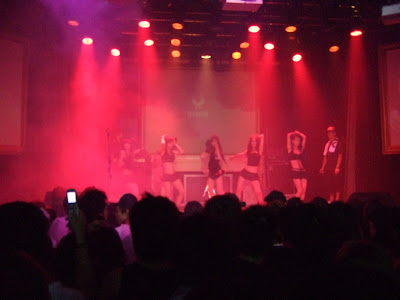
It was SO crowded. People everywhere! We could barely move around. The DJ in front was supposed to be someone famous I think, though I have no idea who it was. Dancing was not really possible at that spot, people were squeezing through just to get in and out. Ah, the lucrative market of Taipei! Just to think of all these people that all paid 600 for their way in. What a business!

Back at the dorm, Leszek had asked me how to say 「你的眼睛很漂亮」, and carefully wrote it down in his palm. Sure enough, he was tapping a girl on the shoulders and induced a giggle out of her. Foreigners with profound features and great body (see Lain) are charming enough, even more so when they're trying to speak Chinese, I guess. I really started to consider the possibility of pretending I don't speak Chinese.

After a while I started to wander around. It was amazing to see the constant stream of people pouring in! All the girls were dressed attractive while maintaining a low mass of clothes on them (Gee, I wonder the correlation between that). And the boys...well I guess I sort of neglected them, as I had forgot. Lots of people were smoking, but I lost track of the scent after an hour or so in there.
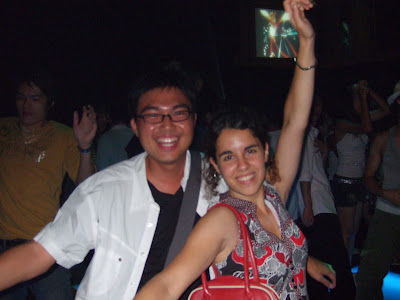
In the back, lots of people had a bored look on their face. I wondered what they were here for? Obviously they weren't here the first time, otherwise they'd be poking their head everywhere like me. Do they come to dance? Do they come so they could meet new people? Are they waiting for someone? Or waiting for a stranger to say hello first? There were spaces along the sides, and one in the middle, but once you sit down you lose sight of the stage.

What drives people to this place? Do they have too much energy that must be expelled by dancing? Is it a place friends hang out? For meeting new friends? Or is it just because they have nowhere better to go? (Even more unlikely, in my opinion, for the music?) I haven't got it figured out quite yet.

其實嗨只有一種,就是自嗨。Even in a "high" place like this, with the music booming and a thousand people twisting their body around you, doesn't automatically make you dancing. One has to deliberately make that decision to loosen up and join in. The way I see it, it's no different than dancing to music in your own room or anywhere else, albeit with lower barriers maybe.
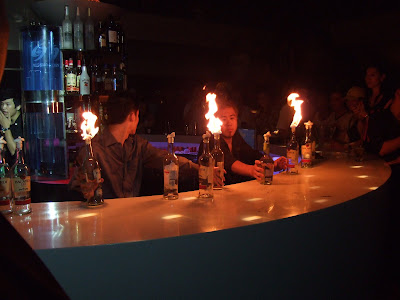
The bar show was great! The host was actually taking all the attention front stage, where the Flatland Shadows or something was going to perform. I was making my way around the bar when the guards appeared and asked us (and shoving us) out of the way to a safe distance. I've never seen a bar show like this before! Fire-lit liquor bottles were flying high and low in the bartender's hands, and rhythms to this insanely fast music. He seemed if he could command the bottle where to go, although once or twice the bottle fell out of his hands. The show ended with a giant flame torching (OK, not really torching) the stack of liquor in the middle, created by the bartender breathing fire. It was awesome!

The Flatland Shadows weren't so great, mostly because I didn't even see them. Front row at the bar show, I was way far from the stage. I gave up, and so did all the girls who were obviously much shorter than me. Wandering a little more, I found another room where it was actually possible to dance. With my admittance there was a voucher for a drink, but my quest for the drink didn't go to well. 「這個是在這裡換嗎?」「甚麼?」「這個是在這裡換嗎?」「甚麼?我聽不到!」「…」「你要換什麼?」I had no idea what to choose from! Obviously we had trouble communicating, even in Chinese, so I settled for a Heineken.
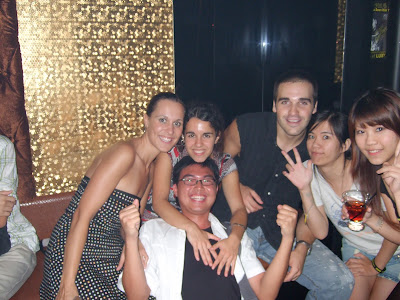
After a while everyone came over to this room. They had met a couple people from 東吳, who were hosting a few Japanese guests, although the guests were enjoying themselves elsewhere in the room. Again, I failed to make new friends but for my foreign buddies...

I can see how alcohol fits into this formula. Blasting music with ultra bass, I could even feel my arms vibrating; Constantly flashing lights making everything look staccato, and probably triggers epilepsy; A room where nobody knows who you are, and your face is just plain not visible in the dark. Sounds like a carefully planned setting to demolish your own identity. So while you're at it, why not add a little alcohol to distort your mind more? At its best, you'll be shaking your head up and down in a lot of strangers who don't know or care who you are, and what troubles you might have. Neither would you care, hopefully. That's the point of it all, isn't it?
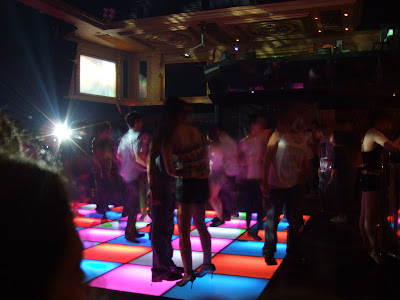
At 4am the folks decided to call it a night and head home. They had to be up and alert tomorrow at the hospital! Fortunately I had a empty day before me to sleep through. I don't know whatever happened to the plan to take a taxi, but we decided to walk home. It's not really that far, but a whole night out can make you tired. As I waved them adios at 善導寺站, the sky was already brightening up. We concluded the day(night?) by watching the sunrise on the rooftop of the dorm, before going to sleep at 6. All in all, a worthy experience no doubt!

2007年7月13日 星期五

隻字片語 / Copenhagen

I'm now in the airport of Copenhagen. It's a fairly big airport, so we were asked to check-in 3 hours before departure. The computer systems were somehow faulty, so we got into various situations: some had two boarding passes, while some only had one. A couple of people had their luggage destined for Hong Kong instead of Taipei. It's going to be a tough job for the tour guide at Hong Kong.

We walked through the itinerary again on the way to the airport. Now, the 15-day trip seemed so short. The places we visited were still vivid images in my head, as if we had just been yesterday. I especially liked Finland and Santa Claus village. It'd be the place I choose if I could only visit one place. Sweden is nice, with a proud history. Norway has a rich scenic collection, and an astounding oil reserve. Denmark is like a giant playground. It is impossible to know the countries in such a short trip, there are many aspects we didn't have the fortune to explore. The people, the food, the culture...I believe that my perception of a place would be much different given I had the time to really experience it.

Yet it has still been a wonderful experience. After all, every deep attachment has so start with a first encounter! I have set my foot on this land, and one day perhaps I will manage to bring the rest of my body.

2007年7月11日 星期三

隻字片語 / Oslo

Ah, I'm going crazy! The only itinerary today is the drive from Bergen to Oslo! It's 490 kilometers, and it's going to take all day. Not really amusing at all.

Bergen was an interesting city, though. The Brygges houses were quite unique, and so was the layout of the city itself. Bays penetrated the city, reaching beyond to form fjords. It was a pity the shops closed so early though, or else we might have had the chance to know the city more. Through the windows, we could see the numerous design products of the shops. They were interesting enough viewed from outside the windows.

Back to the bus!

2007年7月8日 星期日

隻字片語 / Trondheim

As I sat in front of this terminal, I realized nothing much happened today. We first drove from Storslett to Tromsø, where the cable car was out due to a mechanical error. We visited a polar museum where most of the explanation boards were in Norweigan. Our next city on the itinerary was Trondheim, but there was no direct flights from Tronsø to Trondheim. We had to fly to Oslo, which was south of Trondheim, then north to Trondheim. Now I'm at the hotel in Trondheim after a far but not so interesting day. Tomorrow another 400km drive awaits...well, at least I'll be seeing more fjords!

2007年7月6日 星期五

隻字片語 / Nordkapp

Last midnight we visited Nordkapp, the northest point of the european-asian continent. Yes, midnight! We were hoping to see the midnight sun, to witness the 24-hour long day. Unfortunately the weather was not as well as we would like. Heavy fog surrounded the island Nordkapp was on. Visibility was less than 50m, strong winds blew the fog right on to our faces. My hair and glasses were all wet after a trip outside!

We continue our travels into Norway, the highlight of our trip. The glaciers and the fjords, here we come!

Godpig is behind me two days. I hope he is fortunate to have good weather and rendezvous with the midnight sun!

2007年7月5日 星期四

隻字片語 / Ivalo

After 3.5 hours drive, we have arrived at Ivalo. I just had my first Finnish sauna! Sauna is a very important part of Finland culture. It is said there is a sauna utility for every three Fins. Inside the sauna chamber there is a pile of heating rocks. We poured water on to the rocks and it fills the chamber with steam. With the steam, the room becomes very hot although the temperature may not be really very high. Then we go to the cold pool and jump right in! It is said Fins build their sauna chambers next to lakes, and they jump from the steam room right into the freezing lake. The temperature difference can be up to 100 degrees!

The visit to Santa Claus village was an interesting experience. A white line labeled "The arctic circle" pointed out where it was. I haven't thought about this before, but what is the purpose of the arctic circle, and why is it at such a bizzare place such as 66°33'07"? Anyway, in summer and in north of the arctic circle, the sun rarely disappears. Tomorrow, we will have the chance to see the midnight sun!

2007年7月4日 星期三

隻字片語 / Rovaniemi

Good morning to the world! It's 6:30AM, and I'm up due to a little jet lag but mainly because I had finished my diary on the airplane and had nothing to do, and slept at 10.

Yesterday we toured the city of Helsinki, a lovely city by the sea. Although being the capital of Finland, it gave me a sense of a small village. People were at ease, cars slowly moved along without hurrying, and the largest market didn't feel large at all.
By not large, I mean the vendors wasn't eager to make business, neither were the clients bustling in and out. Everything just happens like a slow motion film, as you would expect on a small town where there is only one main avenue. But this is Helsinki, the capital of the nation. Well, I guess it's just their pace of life!

We took a Blue1 flight to Rovaniemi. Blue1 is a budget airline of the SAS group. I had never taken a budget airline before! A menu on the plane listed the various snacks, drinks, and spirits you could order. To my surprise, quite a lot of people bought drinks and snacks! The prices were quite fair, though.

Rovaniemi is very near the arctic circle. Today we will cross the arctic circle, and go visit Santa Claus! I don't think I've been this north before. Night is as bright as day, the sky at 10PM made us feel like it was in the afternoon. Temperatures are cozy, right now it's 18C, so I'm still in T-shirts.

I have no complaints for this region whatsoever, except for one thing: the Chinese food here is, well, not quite a delicacy. I hope we have more Nordic meals!

2007年7月2日 星期一

隻字片語 / Stockholm

Just finished a luxurious breakfast at the hotel. After a good night's sleep, I'm ready to explore the great northern europe! The temperature here is 19C, quite comfortable during the day, but a bit chily in the night, when it can drop to below ten degrees. Today we tour the city of Stockholm, visiting its city hall, viking museum and palaces. Tonight we will board a ship and sail to Helsinki on a 15-hour cruise. Hopefully you can hear from me then!

隻字片語 / Stockholm

Finally, after nearly 24 hours of flight, we have arrived at Stockholm. It is now 1:30 AM, which is 7:30 AM in Taiwan. I am really sleepy, and am going to sleep now. Hello to everyone from Sweden!

Just finished a luxurious breakfast at the hotel. After a good night's sleep, I'm ready to explore the great northern europe! The temperature here is 19C, quite comfortable during the day, but a bit chily in the night, when it can drop to below ten degrees. Today we tour the city of Stockholm, visiting its city hall, viking museum and palaces. Tonight we will board a ship and sail to Helsinki on a 15-hour cruise. Hopefully you can hear from me then!

2006年3月14日 星期二

Perhaps you're right

Perhaps you're right. Perhaps all of you people out there are right, that we cannot change this world.

You argue that what can be changed has already been changed. Those that have not, cannot be changed. After weighing the pros and cons, it is just not feasible to commit the changes. There are consequences to changing. Conflicts of interest to be handled, old habits to be broken, and short-term profits just too hard to let go. Plus there's no way to tell the outcome, absolutely not a pleasant process, and possibly there's no feedback of any kind at all.

You have a point. We are more or less in an equilibrium: what can be changed has already been changed, what's left cannot be changed simply because there is no reason to do so. Say, a pebble gets stuck on the river bed. It was moving, and it still has the potential to move, but it's stuck. Why? Because there's sand on the river bed. The friction stops it from moving. The friction from the sand counters the force of the current. The pebble simply does not move. There, you have it. What doesn't change doesn't change.

Why do old bad habits stay around? Because the there are no immediate benefits present, but it hurts instantly. Because you evaluate the situation, and decide it is not worth the trouble. Because you deny yourself the chance to try. Because you don't believe in yourself.

And perhaps you are right.

You are right in believing that the world cannot change, you cannot change, and there is nothing you can do. And you will be correct, correct solely because you believe so. Therefore you will not make any effort to change, to improve, to try and do something.

But I refuse to comply.

I am not giving in to this false belief you speak of. I refuse to. There will always be a part of me that will try and contribute, to do something good for the world. It will always be my quest to improve upon myself. The world can be a better place. I can be a better man. I may very well falter or fall, but that will not stop me. At the end of the day, I may have changed something, or I may have made no difference at all. No matter what, I tried, and will continue trying.

I will, and I can, because I believe so.